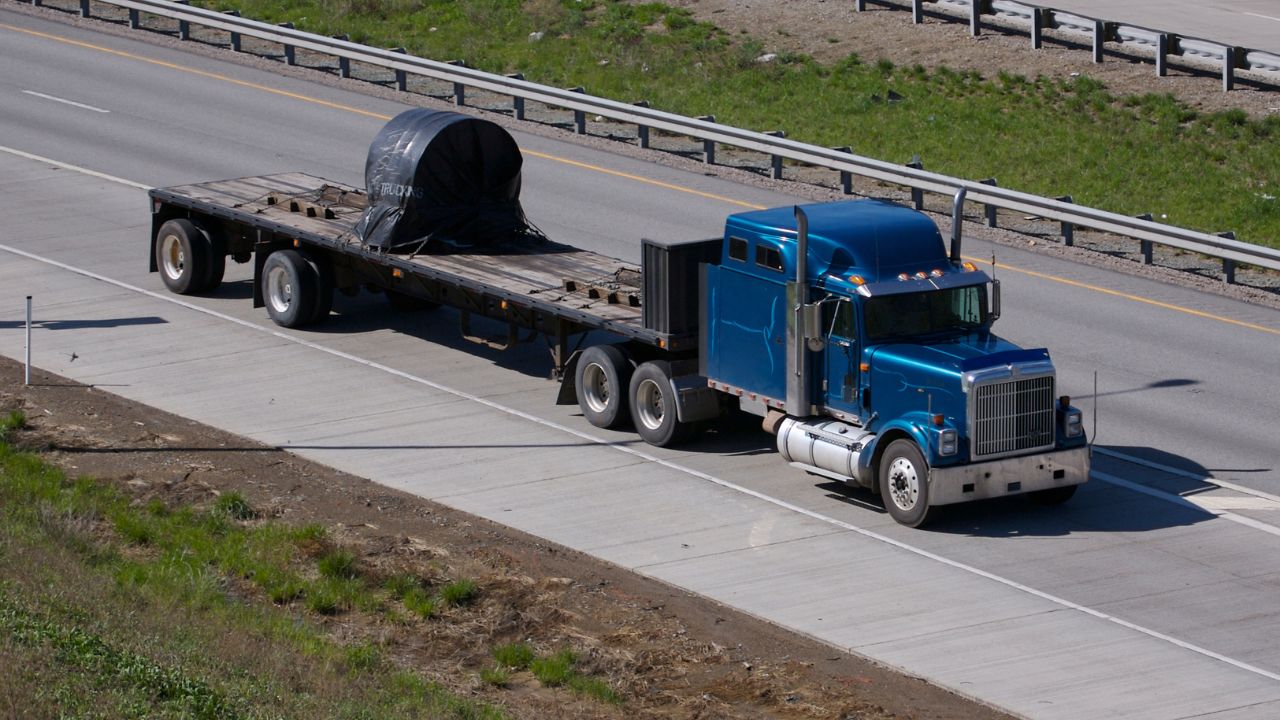
Load securement failures expose flatbed truckers to catastrophic financial and legal consequences. Improperly secured cargo can shift during transport, causing accidents that result in injury, property damage, and massive jury awards. Federal and state regulations establish strict performance standards for securement equipment, yet many operators underestimate the liability risks of inadequate equipment or improper procedures.
Equipment selection, regulatory compliance, and insurance coverage determine whether a flatbed operation survives a claim. Commercial trucking insurance premiums have risen dramatically, while jury verdicts in cargo-related accidents now regularly exceed $10 million. Operators must understand how securement choices directly impact liability exposure and insurance costs.
Key Takeaways
Load securement liability holds truckers financially responsible for damages caused by cargo that shifts or falls from their flatbed. This liability extends beyond immediate accidents to include subsequent collisions, traffic disruptions, and delayed response costs. Insurance carriers scrutinize securement practices during underwriting, with inadequate equipment or non-compliance triggering premium increases or coverage denials.
Poor securement affects every aspect of a trucking operation. A single incident can destroy an owner-operator's business through direct damages, legal fees, and permanent insurance market restrictions. Fleet operators face multiplied exposure across every vehicle, with one major claim potentially triggering rate increases for their entire operation.
Working Load Limit determines the maximum force a securement device can handle under normal conditions. Each piece of equipment must display its WLL rating, which varies by material grade and construction method. Grade 70, 80, and 100 designations refer to high-strength steel classifications in chain manufacturing, with higher numbers indicating greater tensile strength per link.
Proper load securement requires matching equipment capacity to cargo weight and distribution. A Grade 70 chain rated at 3,150 pounds WLL cannot safely secure cargo requiring 4,500 pounds of restraining force. Operators must calculate total securement capacity across all tie-down points to ensure adequate protection during transport.
FMCSA cargo securement standards mandate that systems must withstand 0.8 g deceleration in the forward direction, meaning securement equipment must restrain cargo at 80% of its weight when braking. Regulations also specify 0.5 g acceleration rearward and 0.5 g lateral acceleration, creating three-dimensional restraint requirements.
Performance-based regulations mean operators cannot simply count tie-downs but must prove adequate restraining force. Commercial truck insurance requirements increasingly demand documented compliance with these standards. Inspectors can place vehicles out of service immediately if securement fails the minimum standards.
Nuclear verdicts represent jury awards exceeding $10 million in liability cases involving commercial vehicles. These massive judgments have become increasingly common in California and other plaintiff-friendly jurisdictions. Failure to comply with FMCSA regulations results in fines ranging from $500 to $14,619 per violation and creates presumed negligence in subsequent liability claims.
Cargo theft has reached record highs in California, adding another dimension to load securement liability. Inadequately secured cargo invites theft, potentially triggering cargo protection claims against the carrier. The driver shortage forces fleets to hire younger, less experienced operators who may lack proper securement training, increasing accident likelihood and rising costs for vehicle repairs due to expensive sensors and ADAS technologies.
Effective load securement depends on matching equipment type to cargo characteristics and transport conditions. Chains excel at restraining heavy machinery and steel products requiring maximum holding force. Synthetic straps work best for lighter loads and finished goods where surface protection matters.
Choosing between securement methods involves balancing initial cost, operational efficiency, and long-term durability. Equipment that saves loading time may create safety risks or regulatory violations. Operators must evaluate each method's performance under real-world conditions, including weather exposure, vibration, and repeated use cycles.
Chains and binders represent 45-50% of the mid-range market tier for heavy-duty flatbed operations. Synthetic webbing in ratchet straps is gentler on cargo surfaces and costs significantly less than chain assemblies. However, ratchet straps have lower Working Load Limits compared to equivalent-sized chain systems, typically maxing out at 5,400 pounds WLL versus 8,800 pounds for Grade 80 chains.
Ratchet straps are susceptible to UV and chemical damage that reduces effective lifespan and load capacity. Prolonged sun exposure degrades polyester webbing, creating invisible weak points that fail under load. Chains maintain consistent strength throughout their service life unless physically damaged by corrosion or mechanical stress, though they capture only 25-30% of the overall securement market due to higher initial costs.
Lever binders use a lever and tension hook to tighten chains through mechanical advantage. They provide quick unbinding and high strength but require significant manual force during tensioning. Ratchet binders use a ratcheting mechanism with cam and pawl components for incremental tension adjustment.
Lever binders pose a significant risk of snapback injuries when the lever releases unexpectedly during loosening. Ratchet binders offer controlled incremental tensioning and safer operation through their pawl-and-ratchet design, but require more time for both application and release. Controlled tension adjustment of ratchet binders prevents over-tensioning that can damage cargo or securement points.
Finished steel products and heavy machinery require chain securement to prevent shifting under extreme forces. Insurance requirements change by cargo type, with carriers demanding specific equipment certifications for hazardous materials or oversized loads. Lumber and building materials typically allow strap securement due to lower density and surface damage susceptibility.
Equipment selection must account for the loading environment and destination requirements. Construction sites may lack proper chain storage, making quick-release straps more practical despite lower capacity. Steel mills expect chain securement as the industry standard, with strap use sometimes triggering delivery refusals.
Insurance coverage directly correlates with load securement practices through underwriting risk assessment. Carriers evaluate equipment quality, maintenance records, and compliance history when determining premium rates. Poor securement practices create claim patterns that trigger rate increases or coverage termination regardless of actual accident history.
Comprehensive liability coverage becomes essential when hauling high-value cargo or operating in congested urban environments. Cargo protection policies specifically address damage to goods being transported, while auto liability covers third-party injuries and property damage. Operators who invest in premium securement equipment often qualify for reduced premiums through demonstrated risk mitigation.
Auto Liability coverage provides protection against third-party bodily injury and property damage claims arising from accidents. This mandatory coverage forms the foundation of any truck insurance program, with minimum limits of $750,000 required for most interstate operations. Physical Damage coverage protects the operator's truck and trailer against collision, comprehensive, and specified perils losses.
Cargo Legal Liability specifically addresses the carrier's responsibility for damage to goods being transported. General Liability extends protection to premises operations and non-trucking exposures such as loading dock accidents. Each coverage type addresses distinct liability exposures that flatbed operations face daily.
Fleet insurance evaluates overall risk across multiple vehicles rather than pricing each truck individually. This pooled risk approach typically becomes available for operations with five or more vehicles. Single truck policies offer tailored coverage with specific ratings for each vehicle and driver but result in higher per-unit costs ranging from $5,400 to $7,440 annually.
Fleet insurance provides cost efficiency through bulk discounts of 15-25% and administrative simplicity with unified renewal dates and consolidated billing. However, fleet policies offer limited customization per vehicle, applying standardized coverage across all units. Fleet insurance versus individual truck policies requires careful analysis of your operation's size and growth trajectory.
High-risk operations, including hazmat transport and oversized loads, face premium rates exceeding $10,000 annually for single truck coverage. Nuclear verdicts force insurers to maintain larger loss reserves, directly increasing base premium rates. One severe claim can impact an entire fleet's premium under fleet insurance structures, as carriers reassess the operation's overall risk profile.
Commercial auto premiums have increased for over 45 consecutive quarters through 2026. The cumulative effect creates financial pressure on operators already facing elevated fuel and maintenance costs. Documented compliance with FMCSA securement standards and investment in quality equipment represent the only proven methods to moderate premium escalation.
Equipment selection decisions balance multiple competing priorities, including regulatory compliance, operational efficiency, and budget constraints. Cost influences 28% of load securement equipment decisions among flatbed operators. Coverage limits influence 24% of equipment decisions, while compliance considerations drive 22% of purchases, reflecting the regulatory reality that inadequate equipment creates both immediate penalties and long-term liability exposure.
Performance and durability account for remaining decision factors, with operators increasingly recognizing false economy in budget-tier equipment. A $25 ratchet strap that fails during transport costs exponentially more than its $92 Grade 70 chain alternative. Insurance carriers increasingly require specific equipment grades for high-value cargo, making premium equipment a prerequisite for accessing lucrative freight contracts.
Owner-operators running 1-3 trucks face direct budget pressure that makes equipment cost a primary concern. Initial equipment investment competes with immediate operational expenses, including fuel, maintenance, and insurance premiums. However, compliance influences 22% of purchase decisions as operators recognize that FMCSA violations trigger cascading costs through fines, increased insurance rates, and potential contract losses.
Performance requirements force operators to balance cost against practical utility and safety margins. Equipment that barely meets minimum WLL standards provides no safety buffer for load shifts or unexpected forces. Technical innovations in the trucking industry increasingly emphasize safety features that reduce both accident risk and insurance exposure.
Auto Liability scores 100 priority points for tow truck operators, representing mandatory baseline coverage. On-Hook Towing coverage scores 90 priority points, protecting non-owned vehicles while being towed. Physical Damage scores 85 points, reflecting significant capital investment in tow trucks and specialized equipment.
Garagekeepers Liability covers customer vehicles stored on premises awaiting service or release, addressing unique exposure tow operators face when temporarily possessing customer property. General Liability rounds out essential coverage, scoring 60 points for protection against premises-related claims and non-trucking operations.
Commercial trucking insurance markets experienced unprecedented rate escalation between 2022 and 2026. Commercial auto premiums increased 15% between 2022 and 2023 as carriers adjusted to rising claim severity. Premiums then increased 22% between 2023 and 2025, creating a cumulative premium increase of 37% over four years.
This sustained rate pressure reflects fundamental shifts in liability exposure and equipment costs. Nuclear verdicts create unpredictable loss potential that traditional actuarial models cannot accurately price. California environmental regulations impact truck insurance through mandatory equipment upgrades and increased vehicle replacement costs.
Rising equipment repair costs due to expensive sensors and ADAS technologies increase claim severity for even minor accidents. Modern trucks incorporate collision avoidance systems, lane departure warnings, and adaptive cruise control, requiring specialized calibration after repairs. A fender-bender that once cost $3,500 to repair now exceeds $8,000 due to sensor replacement and recalibration requirements.
Cargo theft reaching record highs in California forces insurers to increase cargo coverage premiums and implement stricter security requirements. The shortage of experienced drivers compels fleets to hire younger operators with limited training, statistically increasing accident frequency. These combined factors create upward pressure on premiums that shows no sign of moderating through 2026.
The California Air Resources Board requires trucks with engines from model year 2010 or newer. This mandate forces expensive fleet upgrades or replacements for operators running older equipment. Compliance costs directly impact insurance rates as carriers factor equipment age and emissions compliance into underwriting decisions.
CARB regulations combine with FMCSA load securement standards to create layered compliance requirements. Operators must simultaneously meet federal cargo securement specifications and state environmental mandates. Fleet owners thriving in the trucking industry challenge adapt by investing in compliant equipment and comprehensive training programs that reduce violation risks.
Telematics systems document driving behavior, load securement procedures, and route compliance in real-time. Insurers increasingly rely on this data-driven approach to underwriting, offering premium discounts for fleets that demonstrate consistent safe operation. Dash cams provide crucial evidence in disputed claims, protecting operators from fraudulent liability accusations.
Electronic logging devices mandated by FMCSA regulations now integrate with telematics platforms to create comprehensive operational records. Protecting your fleet with the best insurance requires leveraging these technologies to document compliance and demonstrate risk mitigation efforts. Carriers that embrace telematics gain competitive advantages through data-supported risk profiles.
Equipment and insurance costs directly impact operational profitability for flatbed truckers. Budget constraints remain the top consideration for independent owner-operators who must balance immediate cash flow needs against long-term risk management. However, false economy in equipment selection creates liability exposure that dwarfs initial cost savings.
Insurance premiums now consume 8-12% of gross revenue for many flatbed operations, up from 5-7% in 2020. This expense increase competes with fuel and maintenance costs for budget priority. Operators must strategically allocate resources to maximize protection while maintaining competitive pricing.
Budget-tier ratchet straps cost $14-$25 per unit, providing entry-level compliance for light loads. These basic straps lack the durability and capacity required for heavy-duty applications. Entry-level lumber hauling kits cost approximately $1,100.
Grade 70 chain and binder kits cost $62-$92, representing the mid-range tier for serious flatbed operations. Comprehensive steel hauling kits cost approximately $1,725, including heavy-duty chains, multiple binders, and accessory equipment. High-capacity Peerless chains cost $118 or more per assembly, targeting premium operations hauling maximum-weight loads.
Single truck insurance ranges from $5,400 to $7,440 annually for standard operations hauling general freight. High-risk single truck insurance covering specialized operations can exceed $10,000 annually. Fleet insurance offers 15-25% bulk discounts, reducing per-truck costs to $6,000-$8,000 annually for qualifying operations.
Premium variations reflect cargo type, operating radius, and driver experience levels. Interstate haulers pay more than local operators due to increased exposure and regulatory complexity. High-value cargo, such as machinery or electronics, triggers additional cargo coverage requirements that increase total insurance costs.
Strategic equipment investment focuses on high-use items where quality directly impacts safety and efficiency. Chains used daily for steel hauling justify premium pricing, while occasional-use equipment can accept mid-range quality. Insurance purchasing should prioritize adequate liability limits over minimal premium costs, as a single nuclear verdict exceeds decades of premium savings.
Operators must resist short-term cost-cutting that increases long-term liability exposure. Deferred maintenance on securement equipment creates documented negligence in liability claims. Insufficient insurance limits leave personal assets exposed when claim amounts exceed policy limits, potentially destroying both business and personal financial security.
Comprehensive risk mitigation requires addressing equipment quality, operational procedures, and insurance adequacy simultaneously. No single improvement eliminates liability exposure, but layered protections significantly reduce both accident likelihood and claim severity. Documented compliance provides crucial legal protection when incidents occur.
Training programs emphasizing proper securement techniques reduce both accident frequency and equipment damage. Regular equipment inspections identify worn components before they fail during transport. Insurance relationships with carriers specializing in trucking risks ensure a proper coverage structure and responsive claims handling.
Priority investments should target equipment used for the highest-risk loads and most frequent applications. Grade 80 or Grade 100 chains provide safety margins that prevent cascading failures when loads shift unexpectedly. Ratchet binders eliminate snapback injury risks while providing more precise tension control than lever alternatives.
Equipment maintenance schedules must account for usage intensity and environmental exposure. Chains require regular inspection for deformed links, cracks, or excessive wear that reduces rated capacity. Synthetic straps need replacement when UV damage or abrasion compromises webbing integrity, typically every 12-18 months for daily-use applications.
Operators managing five or more trucks should transition to fleet policies for immediate cost savings. The 15-25% discount available through pooled risk evaluation substantially reduces per-truck costs. Consolidated administration eliminates multiple renewal dates and streamlines certificate requests.
Fleet structures also simplify scaling operations as adding vehicles requires simple policy endorsements rather than entirely new insurance placements. However, operators must recognize that claim activity on any fleet vehicle affects the entire operation's renewal pricing. Strong safety cultures and driver training programs become essential to protect fleet-wide insurance costs.
Dash cams recording forward-facing and driver-facing views provide objective evidence in disputed claims. Time-stamped footage protects operators from fraudulent accusations and documents actual accident sequences. Telematics systems tracking speed, braking, and cornering forces demonstrate professional driving behavior that supports favorable insurance underwriting.
Load monitoring sensors detect cargo movement during transport, alerting drivers to potential securement failures before accidents occur. GPS tracking provides route documentation and confirms proper rest periods. These combined technologies create operational records that satisfy regulatory requirements while supporting liability defense in litigation.
Flatbed truckers operating in California face unique liability exposures from strict regulations, high traffic density, and plaintiff-friendly legal environments. Load securement liability creates direct financial risk through accident damages and indirect risk through insurance premium escalation. Proper equipment selection matched with adequate liability coverage forms the foundation for sustainable flatbed operations.
The 37% cumulative increase in commercial trucking insurance premiums since 2022 reflects fundamental market changes driven by nuclear verdicts and rising claim costs. Operators who invest in premium securement equipment and comprehensive coverage packages position themselves to weather ongoing market challenges. SoCal Truck Insurance understands the specific pressures facing flatbed operators and provides specialized coverage structures designed for California's demanding operating environment.
Load securement liability can wipe out years of hard work in a single incident. You need an insurance partner who understands the equipment standards, the FMCSA scrutiny, and the California claim environment shaping your premiums today. That partner is SoCal Truck Insurance.
For more than 25 years, we have placed coverage for flatbed owner-operators and fleets across Los Angeles, the Inland Empire, San Diego, Orange County, and Long Beach. Our specialist agents shop multiple carriers, including Progressive, Canal Insurance, and Infinity, to build a policy that matches your cargo, your routes, and your budget. Auto liability, physical damage, cargo legal liability, and general liability work together as one program, not as separate problems for you to solve.
You also get a dedicated bilingual agent, 24/7 support when claims and roadside emergencies happen, and clear answers on how your securement practices affect what you pay. Contact us today to discuss customized insurance solutions that protect your operation without unnecessary administrative burden.